Crypto market has a way of shifting moods faster than most traditional investors can process. One month it’s all about Bitcoin dominance and cautious positioning, and the next, capital rotates aggressively into smaller assets that suddenly feel “undervalued.” Right now, the Altcoin Season Index is rising—and for many traders and long-term investors, that’s not just an interesting metric. It’s a signal that the market may be entering one of its most opportunistic phases.
If you’ve been watching the market closely, you’ve likely noticed that altcoins are beginning to outperform Bitcoin over short periods, while social media chatter, liquidity movement, and trading volumes are expanding across different segments. A rising Altcoin Season Index doesn’t automatically mean the market is about to explode—but it does indicate that the conditions for broader altcoin outperformance are developing.
What makes this moment especially intriguing is that many of the historical markers of a mature altcoin season—such as extreme euphoria, overheated leverage, and full-blown retail mania—don’t appear to be fully present yet. That’s one reason many analysts believe the Altcoin Season Index still has more room to go. In other words, the market may be shifting into altcoin territory, but it may still be early in the rotation.
In this article, we’ll unpack what the Altcoin Season Index really measures, why it’s rising, and why it could continue climbing. We’ll also explore the relationship between Bitcoin dominance, macro liquidity, narratives like AI and layer-2 growth, and the role of stablecoins in fueling momentum. Most importantly, you’ll learn how to interpret the signals so you’re not chasing hype—but positioning with clarity.
What Is the Altcoin Season Index and Why Does It Matter?
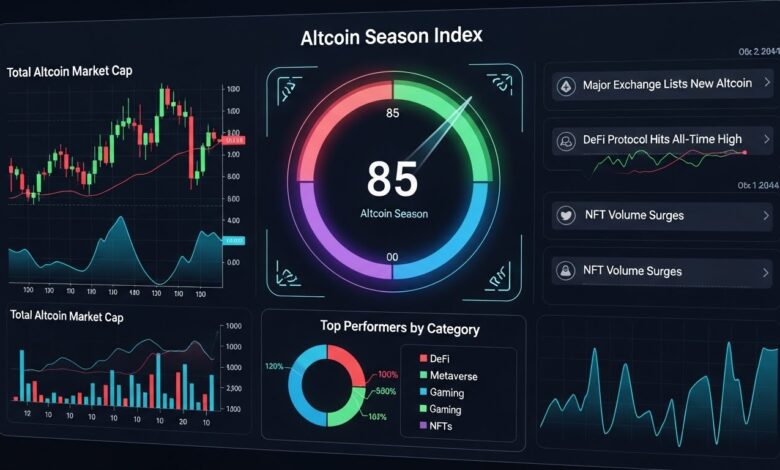
The Altcoin Season Index is a market indicator designed to measure whether altcoins are outperforming Bitcoin over a specific timeframe, typically 90 days. While different platforms may calculate it slightly differently, the core idea is consistent: when a large percentage of top altcoins outperform Bitcoin, the market is likely in “altcoin season.” When Bitcoin outperforms most altcoins, the market is generally considered to be in “Bitcoin season.”
This matters because crypto markets tend to rotate. Capital does not move randomly—it often flows in phases. First, Bitcoin leads and establishes momentum. Then Ethereum often follows as confidence increases. Finally, as traders search for higher returns, money rotates into mid-cap and small-cap altcoins, creating the kind of explosive rallies that define classic altcoin cycles.
A rising Altcoin Season Index suggests that this rotation is already in motion. It’s not just about price increases in a few popular tokens. It’s about breadth: the performance spreading across multiple sectors and multiple projects. When that breadth increases, the Altcoin Season Index climbs—and that shift can be one of the earliest and most valuable signals in the market.
Why the Altcoin Season Index Is Rising Right Now
A rising Altcoin Season Index usually happens when several forces align at the same time. Price action alone isn’t enough. The broader market structure has to support risk-taking, liquidity must return, and narratives need to capture attention.
Capital Rotation From Bitcoin Profits
One of the most common reasons the Altcoin Season Index rises is capital rotation. When Bitcoin rallies strongly, early investors and large holders often take profits. But instead of exiting the market entirely, they frequently reinvest those profits into altcoins that appear undervalued or lagging behind.
This rotation is especially powerful because Bitcoin profits act like fuel. They increase available liquidity, and they create confidence that the cycle is “on.” When traders feel that Bitcoin has already moved, they chase stronger potential returns elsewhere—and that’s exactly when the Altcoin Season Index starts climbing.
Growing Confidence in Risk-On Assets
Altcoins are inherently riskier than Bitcoin. So, a rising Altcoin Season Index usually suggests that the market is leaning “risk-on.” That means traders are willing to accept more volatility in exchange for higher upside.
This shift often happens when overall sentiment improves, macro fear decreases, and liquidity conditions stabilize. Even if the broader world economy remains uncertain, crypto markets can still trend risk-on when the internal momentum and narrative strength overpower hesitation.
Increased Altcoin Trading Volume and Market Participation
The Altcoin Season Index tends to rise alongside rising spot volume, expanding perpetual futures activity, and new participants entering the ecosystem. When liquidity spreads across more trading pairs and more exchanges, altcoins become easier to buy and sell—and that supports sustained rallies.
In early phases, many altcoins rise quietly. But when participation increases, price action becomes more structural. That’s when the Altcoin Season Index can accelerate more sharply.
Bitcoin Dominance Is the Hidden Driver Behind Altcoin Season
If you want to understand why the Altcoin Season Index is rising—and why it could keep rising—you need to watch Bitcoin dominance.
Bitcoin dominance measures Bitcoin’s share of the total crypto market cap. When dominance rises, it usually means money is concentrating in Bitcoin. When dominance falls, it typically signals that capital is flowing into altcoins.
Why Falling Bitcoin Dominance Supports a Higher Altcoin Season Index
When Bitcoin dominance declines, it doesn’t necessarily mean Bitcoin is crashing. Sometimes Bitcoin still rises—but altcoins rise faster. That relative outperformance pushes the Altcoin Season Index higher.
This is one of the clearest indicators that the market is shifting from “safety mode” into “expansion mode.” In many cycles, the strongest altcoin seasons happen when Bitcoin dominance breaks down from key levels and begins trending lower consistently.
Bitcoin Consolidation Often Sparks Altcoin Outperformance
Another classic pattern is Bitcoin consolidation. After a strong run, Bitcoin often enters a range. During this period, traders become impatient, and capital moves into altcoins where the price action feels more exciting.
This is one of the biggest reasons the Altcoin Season Index can still have more room to go. If Bitcoin continues to consolidate rather than collapse, it often creates the perfect environment for altcoins to outperform without triggering market-wide panic.
Liquidity, Stablecoins, and Why the Market May Still Be Early
The most overlooked fuel behind any altcoin season is liquidity. Without liquidity, rallies fade quickly. With liquidity, rallies become self-reinforcing.
Stablecoin Growth and On-Chain Liquidity Expansion
Stablecoins function like the base currency of the crypto ecosystem. When stablecoin supply expands, it usually means more buying power is entering the market. That added buying power often flows into Bitcoin first, but it doesn’t stop there. As confidence builds, it rotates outward into altcoins, raising the Altcoin Season Index.
The key point is that liquidity often builds before the most euphoric phase begins. If stablecoin flows continue increasing and on-chain activity remains healthy, that suggests the Altcoin Season Index may still have room to climb.
The “Risk Curve” Effect in Crypto Markets
Crypto is a risk curve. Investors move from lower risk to higher risk as confidence grows. First Bitcoin, then Ethereum, then large-cap altcoins, then mid-caps, then small-cap speculative tokens.
When the Altcoin Season Index rises, it often means the market is climbing this curve. But it doesn’t always mean the market is already at the far end. If we’re still mostly seeing strength in large-cap and mid-cap altcoins, that can imply that the most speculative segment hasn’t peaked yet—meaning the Altcoin Season Index could still rise further.
Strong Narratives Are Creating Tailwinds for Altcoins
Altcoins don’t move purely on fundamentals. They move on stories, adoption signals, and collective attention. Right now, multiple narratives are simultaneously pulling capital into altcoin sectors, which is a strong reason the Altcoin Season Index is rising.
The Return of Ethereum Strength and Layer-2 Growth
Ethereum often acts as the bridge between Bitcoin season and true altcoin season. When Ethereum begins to outperform Bitcoin, it’s typically a sign that the market is ready for more risk.

At the same time, layer-2 scaling solutions are expanding Ethereum’s ecosystem. Increased activity and lower fees can lead to higher user engagement, which often benefits a broader set of altcoins tied to infrastructure and DeFi. This ecosystem expansion can keep the Altcoin Season Index rising by creating a larger “surface area” for capital to flow into.
AI, DePIN, Gaming, and Real-World Assets
Narratives like AI crypto, DePIN, gaming ecosystems, and real-world asset tokenization have also been capturing attention. When multiple narratives are active at once, capital doesn’t just chase one sector—it spreads across several.
That creates broad-based outperformance, which is exactly what pushes the Altcoin Season Index higher. It’s one thing for a single meme coin to pump. It’s another thing entirely when infrastructure, utility, and narrative tokens across multiple categories are rising together.
Why the Altcoin Season Index Still Has More Room to Go
A rising Altcoin Season Index is important, but the bigger question is whether it’s near the top—or whether it has more room to climb. There are several reasons why the current move may still be in its earlier chapters.
The Market May Not Be in Full Retail Mania Yet
Historically, the most extreme altcoin seasons happen when retail investors pile in aggressively. You see exponential pumps, nonstop influencer hype, and significant over-leverage.
A market can show early altcoin season behavior before it reaches that phase. If current conditions still look relatively measured compared to past peaks, that suggests the Altcoin Season Index could continue rising as broader participation grows.
Many Altcoins Are Still Below Prior Cycle Highs
In some cycles, the Altcoin Season Index peaks when altcoins massively exceed previous highs, and valuations become difficult to justify. If many quality altcoins are still below prior highs, it can suggest that the market still sees room for catch-up.
That doesn’t guarantee success for every project, but it does indicate that the rotation might not be finished.
The Breadth of Altcoin Outperformance Can Expand Further
The Altcoin Season Index is a breadth indicator. If only a limited set of altcoins is outperforming, the index can rise but stay muted. If more of the market begins outperforming Bitcoin, the index climbs higher.
If the market is currently concentrated in only a handful of sectors, there’s still room for that outperformance to expand across more categories and more coins.
How to Read the Altcoin Season Index Like a Pro
The Altcoin Season Index isn’t a magic “buy” signal. It’s a context tool. The best investors use it alongside other indicators to avoid emotional decisions.
Combine It With Bitcoin Dominance and Market Structure
If the Altcoin Season Index rises while Bitcoin dominance falls, that’s often a stronger confirmation of a true altcoin trend. If the index rises while dominance stays flat, it may mean only certain sectors are running, not the entire market.
Also pay attention to market structure. Strong uptrends tend to have higher lows and consistent demand. Weak, hype-driven pumps often collapse quickly.
Use It to Manage Risk, Not Just Chase Returns
As the Altcoin Season Index rises, volatility increases. That means risk management becomes more important, not less. Smart traders use the index as a signal that the market is changing, and they adjust accordingly.
The goal isn’t to blindly buy every altcoin. The goal is to understand where the market is in the cycle and align your strategy with that phase.
Conclusion
The Altcoin Season Index is rising because the market is rotating into higher-risk assets, liquidity is improving, narratives are gaining traction, and altcoin breadth is expanding. The most important takeaway is that this move may still have more room to go, especially if Bitcoin continues consolidating, stablecoin liquidity increases, and more sectors join the outperformance wave.
Altcoin season isn’t a single event—it’s a phase. And phases evolve. The smartest approach is to stay aware of the indicators, keep emotions in check, and treat the Altcoin Season Index as a guide to market structure rather than a guarantee of easy profits.
If the current trend continues, the Altcoin Season Index could climb further, pushing more capital into altcoins and creating the kind of market environment that historically rewards those who position early—with discipline.
FAQs
Q: What does the Altcoin Season Index measure?
The Altcoin Season Index measures whether a large portion of top altcoins are outperforming Bitcoin over a set timeframe, often 90 days. A higher score suggests stronger altcoin outperformance.
Q: Does a rising Altcoin Season Index mean every altcoin will pump?
No. A rising Altcoin Season Index indicates broad outperformance trends, but many altcoins can still underperform. Strong narratives, liquidity, and fundamentals matter.
Q: How is Bitcoin dominance linked to the Altcoin Season Index?
When Bitcoin dominance falls, it often signals that money is rotating from Bitcoin into altcoins. That usually supports a higher Altcoin Season Index.
Q: Can the Altcoin Season Index drop quickly?
Yes. Crypto rotations can shift fast. If Bitcoin starts outperforming again, or if market risk appetite declines, the Altcoin Season Index can fall sharply.
Q: Is it too late if the Altcoin Season Index is already rising?
Not necessarily. Early rises can indicate the beginning of rotation, not the end. However, the higher the index climbs, the more important risk management becomes as volatility increases.
Also More: Altcoins Are Bleeding While the Crypto Market Shifts