
Blockchain adoption is no longer a “future tech” headline—it’s an operational shift happening in real time. Banks are piloting tokenized deposits, global brands are tracking goods with distributed ledger tools, and payment firms are weaving stablecoins into settlement flows. Yet in the United States, the regulatory picture still feels unsettled to many founders, compliance teams, and institutional decision-makers. That tension—rapid real-world uptake paired with lingering legal ambiguity—has become the defining narrative of this cycle.
A recent analyst note has sharpened that point: blockchain adoption continues to expand even as Washington debates the fine print of market structure, agency jurisdiction, and consumer protections. The message is simple: demand is coming from the ground up. Enterprises and institutions are increasingly choosing blockchain rails because they reduce reconciliation costs, enable near-instant settlement, and create new product design space through tokenization and smart contracts—benefits that don’t disappear just because the rulebook is still being written.
At the same time, “regulatory uncertainty” doesn’t mean “no rules.” It means uneven rules, overlapping enforcement theories, and a pace of policymaking that struggles to match innovation. For many U.S. teams, that ambiguity translates into slower launches, heavier legal review, and cautious go-to-market strategies. But globally—and even within the U.S.—blockchain adoption keeps moving, because the underlying economic incentives are strong. This article unpacks why blockchain adoption is accelerating, where it’s showing up most, how U.S. uncertainty is shaping strategy, and what the next 12–24 months may look like for institutions, enterprises, and everyday users.
Why Blockchain Adoption Keeps Rising Even When Rules Lag
Blockchain adoption is often described as a bet on the future. In practice, it’s increasingly a decision about present-day infrastructure. The strongest driver is not ideology—it’s efficiency. Traditional financial and enterprise systems rely on multiple databases that must be reconciled. A distributed ledger approach reduces duplicated record-keeping and can compress settlement timelines from days to minutes. That change matters to CFOs, treasurers, and operations leaders because it frees working capital and reduces counterparty risk.
A second driver is product innovation. When you represent an asset as a token, you can design programmable features into ownership, transfer, and compliance. That is the promise of tokenization: fractional ownership, automated corporate actions, real-time reporting, and new ways to package exposure. Even conservative firms that don’t want “crypto volatility” still want tokenization’s workflow improvements.

Third, blockchain adoption is benefiting from infrastructure maturity. Custody, key management, auditing tools, compliance monitoring, and enterprise-grade blockchain frameworks have improved dramatically. For many firms, the question is no longer “Is the tech ready?” but “Which use case clears legal, reputational, and ROI hurdles first?” As enterprise infrastructure catches up, it lowers the friction of experimentation and moves blockchain adoption from pilots to production.
The Analyst View: Adoption Expands as Institutions Focus on Utility
One reason the “adoption despite uncertainty” storyline resonates is that institutional priorities have shifted. Institutions are less interested in hype cycles and more interested in utility: settlement, collateral mobility, automated compliance, and modernized capital markets plumbing. In the analyst commentary referenced above, the key claim is that blockchain adoption in institutional finance continues to grow even if legislative efforts for clearer U.S. market structure take longer than expected.
This distinction matters. If blockchain adoption were primarily speculative, regulatory ambiguity could freeze activity. But much of today’s growth is operational and commercial. That includes internal ledger modernization, permissioned networks, regulated tokenized products, and cross-border settlement experiments. The more “infrastructure-like” the use case becomes, the harder it is to reverse, because it integrates into workflows.
Institutional Finance Is Leading the Practical Use Cases
Financial services remains a center of gravity for blockchain adoption because the industry runs on ledgers. Whether it’s post-trade settlement, collateral management, or fund administration, finance has clear pain points that shared ledger infrastructure can reduce. Recent industry coverage continues to emphasize how institutions are exploring tokenized assets and blockchain-enabled market infrastructure as they pursue speed and transparency.
Compliance Is Becoming a Feature, Not a Brake
A common misconception is that compliance and blockchain adoption are opposing forces. In reality, compliance is increasingly a selling point. Properly designed systems can embed controls—like identity checks, transfer restrictions, audit trails, and automated reporting—directly into smart contracts. That can make regulated activity easier to supervise than opaque, fragmented legacy systems. The winners will be those who treat compliance as product design: building systems that are secure, auditable, and regulator-friendly from day one.
What “U.S. Regulatory Uncertainty” Actually Means in 2026
When people talk about uncertainty, they usually mean three things: unclear classification of digital assets, unclear agency boundaries, and inconsistent pathways to registration. Market participants still debate when a token is a security versus a commodity, how secondary trading should be supervised, and what disclosures should look like for different token models. That ambiguity creates risk for exchanges, brokers, custodians, DeFi interfaces, and even enterprise teams that simply want to use blockchain rails.
But the policy environment is not static. There have been visible moves toward coordination and market-structure clarity, including efforts to reduce the long-running tension between the SEC and CFTC over oversight. For example, legal analysis in late 2025 highlighted increased interagency coordination signals, including a joint roundtable focused on harmonization.
Market Structure Bills and the Search for Clear Jurisdiction
Much of the U.S. debate has centered on market structure—who regulates what, and under what standards. Commentary around the proposed “CLARITY Act” framework has emphasized a push to define jurisdiction and reduce the SEC–CFTC turf conflict. While legislation can take time, the direction of travel matters: clearer lines tend to unlock more confident product launches, deeper liquidity, and broader institutional participation.
Banking and Stablecoin Rails Are a Separate (and Faster) Track
Even when broader market structure is debated, stablecoin and banking-related pathways can move faster because they touch familiar frameworks: reserves, audits, risk management, and payments oversight. Coverage has pointed to meaningful regulatory steps for stablecoin-related firms pursuing more formal banking-like structures, suggesting that parts of the ecosystem can advance even while other areas remain contested.
For blockchain adoption, this matters because stablecoins are often the “killer app” bridge between traditional finance and on-chain settlement. If stablecoin rails become more standardized and supervised, they can accelerate blockchain adoption in payments, treasury operations, and cross-border commerce.
The Real Engines of Blockchain Adoption: Use Cases That Pay for Themselves
The strongest blockchain adoption stories are the ones where the numbers work. That means reduced settlement time, fewer intermediaries, automated reconciliation, and lower fraud exposure. It also means new revenue lines: tokenized products, faster distribution, and programmable incentives.
Tokenized Assets and Modern Capital Markets
Tokenization is often described in big terms—“everything will be tokenized.” A more grounded view is that tokenization wins where it simplifies issuance, settlement, and lifecycle management. Private credit, treasuries, money-market-like instruments, and certain fund structures are attractive because they already rely on complex admin workflows. Tokenization can reduce operational overhead while expanding distribution.
Blockchain adoption here isn’t just about putting an asset on-chain. It’s about connecting issuance, compliance, transfer agents, custody, and reporting into a single coherent system. When done well, it can reduce errors and shorten time-to-settlement—benefits that institutions can quantify.
Cross-Border Payments and Treasury Operations
Cross-border payments remain expensive and slow in many corridors. Blockchain adoption offers an alternative: near-real-time settlement with transparent tracking. Treasurers also care about 24/7 movement of funds, especially for global organizations operating across time zones. Stablecoins, in particular, are becoming a practical settlement medium in some enterprise contexts because they can move quickly while remaining denominated in familiar fiat units.
Supply Chain Provenance and Enterprise Data Integrity
Outside finance, blockchain adoption shows up in supply chains where provenance matters: pharmaceuticals, luxury goods, food traceability, and industrial components. The key is not “blockchain for everything,” but “blockchain where multiple parties need a shared source of truth.” A permissioned blockchain can help coordinate data across suppliers and auditors without forcing everyone to trust a single database owner.
Digital Identity, Credentials, and Authentication
Another quiet driver of blockchain adoption is verifiable credentials. Organizations want better ways to issue and verify identity attributes—like licenses, certifications, and access permissions—without centralizing sensitive data. Properly designed credential systems can reduce identity fraud while giving users more control over what they share. This category is especially compelling as AI-driven fraud grows more sophisticated and organizations seek stronger authentication signals.
How U.S. Uncertainty Changes Strategy (Without Stopping Adoption)
U.S. uncertainty doesn’t halt blockchain adoption; it reshapes it. Companies adapt in several predictable ways.
First, they prioritize “lower-regret” use cases—internal ledger modernization, B2B settlement, and permissioned deployments—where consumer-facing regulatory exposure is smaller. Second, they build optionality: modular compliance layers, region-based product rollouts, and partnerships with regulated entities. Third, they invest more in legal engineering: designing tokens and protocols with clearer governance, disclosures, and restrictions to fit anticipated frameworks.
This is why blockchain adoption can accelerate even in uncertain environments: the industry learns to route around ambiguity while policymakers catch up. The cost is friction and slower consumer rollouts, but the direction remains forward.
The Global Competitive Pressure Factor
Another reason blockchain adoption pushes ahead is that the market is global. If the U.S. moves slowly, other jurisdictions can attract talent, liquidity, and headquarters. Even rumors of regulatory tightening or sudden shifts in other hubs can trigger “jurisdiction shopping,” with firms repositioning to friendlier or clearer regions. The U.S. remains influential, but it is not the only arena where blockchain adoption is being shaped.
The Technology Layer: What’s Improving Behind the Scenes
Blockchain adoption becomes easier when the technology behaves like enterprise infrastructure rather than experimental software. Several improvements are reducing perceived risk.
Scalability and performance are improving through better execution environments, rollup architectures, and optimized consensus designs. Interoperability is also getting more practical, enabling assets and data to move across networks without reinventing custody and compliance each time. Meanwhile, security tooling—formal verification, runtime monitoring, and smarter audits—helps teams manage the real risks: key compromise, contract bugs, and operational failures.
A crucial shift is that many enterprises no longer ask “public chain or private chain?” They ask “what blend of trust assumptions and compliance controls do we need?” In other words, blockchain adoption is becoming a spectrum: from fully permissionless networks to tightly permissioned consortia, with hybrid models in between.
Measuring Blockchain Adoption Without Falling for Hype
It’s easy to mistake price action for adoption. Real blockchain adoption shows up in operational metrics: settlement volume, active wallet usage for non-speculative actions, enterprise transactions, on-chain treasury flows, and the number of production integrations.
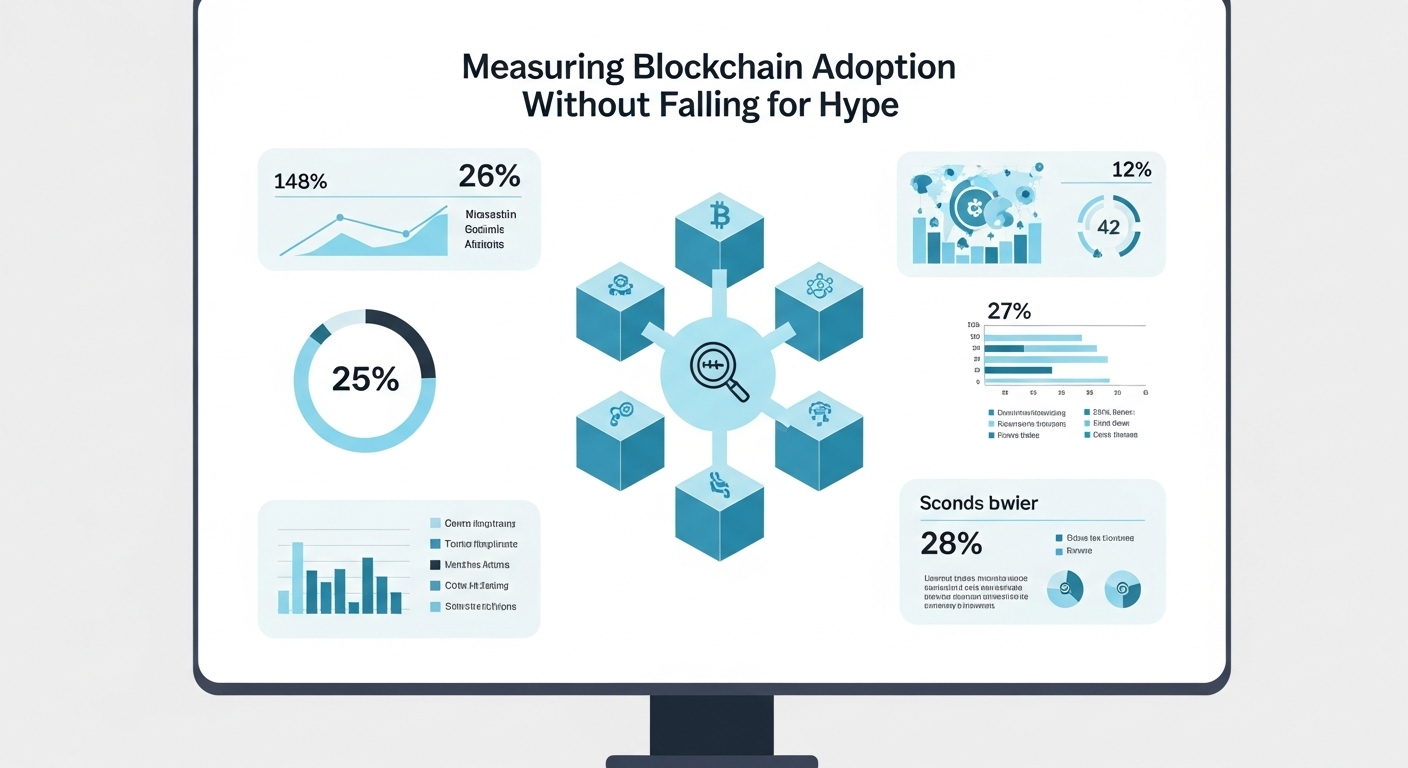
It also shows up in executive behavior. When boards allocate multi-year budgets, when auditors standardize practices, and when compliance teams develop repeatable playbooks, that is adoption. It’s not always visible on social media, but it is sticky. The most meaningful signal is when blockchain usage becomes boring—another system that must work every day.
What Comes Next: Likely Scenarios for 2026 and Beyond
Over the next 12–24 months, blockchain adoption is likely to grow fastest in segments where value is clearest and regulatory pathways are most navigable.
Institutional tokenization should continue expanding, especially for instruments that benefit from programmable compliance and streamlined administration. Stablecoin-based settlement is likely to deepen as more payment and treasury products integrate regulated rails. Enterprise adoption in supply chain and identity will progress where consortia governance is strong and incentives are aligned. Meanwhile, consumer-facing DeFi and exchange services may remain more sensitive to U.S. market-structure outcomes.
Industry watchers expect market-structure legislation and related regulatory actions to remain central topics, with multiple proposals and evolving oversight approaches shaping what “compliant crypto” looks like in the U.S. The bigger point, however, is that blockchain adoption is no longer waiting for perfect clarity; it is building toward it.
Conclusion
Blockchain adoption is pushing ahead because the economic logic is compelling: faster settlement, shared sources of truth, programmable assets, and new financial and enterprise workflows. U.S. regulatory uncertainty is real, and it adds friction—especially for consumer-facing services and secondary markets. But it has not stopped progress. Instead, it has nudged the industry toward compliance-first design, institution-led use cases, and practical deployments that can survive changing rules.
The next phase of blockchain adoption will be less about slogans and more about integration: connecting digital assets to real-world balance sheets, embedding regulatory clarity into product architecture, and turning blockchain rails into invisible infrastructure. As that happens, the winners will be the teams that treat trust, security, and compliance as core features—because in the long run, the most scalable innovation is the kind that institutions and regulators can live with.
FAQs
Q: Why is blockchain adoption growing even with U.S. uncertainty?
Blockchain adoption keeps growing because many use cases deliver immediate operational value—like faster settlement, reduced reconciliation, and improved auditability. Firms can capture these benefits while designing products conservatively to manage legal exposure.
Q: Does regulatory uncertainty stop institutional finance from using blockchain?
Not entirely. Institutions often focus on permissioned systems, tokenized instruments with clear controls, and regulated payment rails. These approaches let blockchain adoption proceed while broader market-structure debates continue.
Q: Are stablecoins a major driver of blockchain adoption?
Yes. Stablecoins enable fast, fiat-denominated settlement, which is highly attractive for payments and treasury operations. As oversight and standards mature, stablecoin rails can accelerate blockchain adoption across enterprises and financial institutions.
Q: What’s the difference between enterprise blockchain and public blockchain adoption?
Enterprise blockchain adoption often uses permissioned blockchain networks with known participants and built-in compliance controls. Public blockchain adoption occurs on open networks where anyone can transact, typically requiring different risk management and governance approaches.
Q: What should businesses consider before starting a blockchain adoption project?
Businesses should start with a clear ROI-driven use case, map compliance and data requirements early, choose an appropriate trust model (public, permissioned, or hybrid), and invest in security practices for keys and smart contracts. The most successful blockchain adoption initiatives treat governance and operational readiness as seriously as technology.
Also More: Blockchain Technology in Africa Viability Future Potential