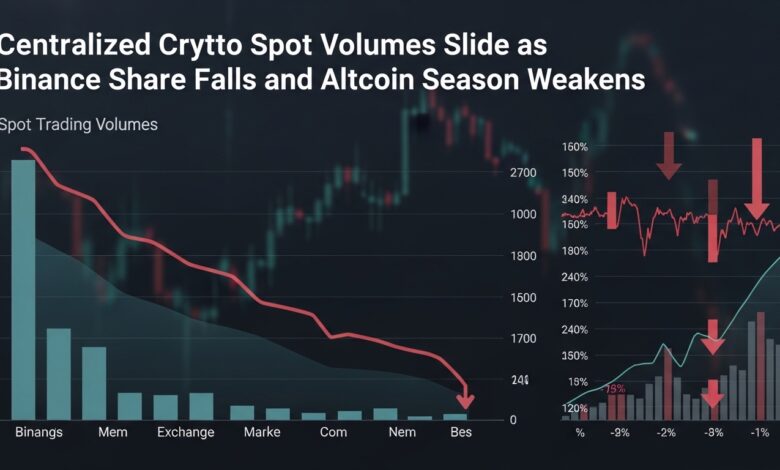
The cryptocurrency market is once again entering a phase of transition. After periods of intense speculative activity and record-breaking rallies, recent data suggests that centralized crypto spot volumes slide across major exchanges. At the same time, Binance’s dominance in global trading has softened, and the long-anticipated altcoin season appears to be losing momentum. These developments are not isolated incidents but interconnected shifts that reflect deeper structural changes in the digital asset ecosystem.
Understanding why centralized crypto spot volumes slide requires more than just looking at short-term market fluctuations. It demands a closer examination of exchange dynamics, investor sentiment, macroeconomic pressures, and evolving regulatory frameworks. As Binance share falls and altcoin season weakens, the broader crypto market is adjusting to new realities, including tighter liquidity conditions, increased compliance scrutiny, and shifting capital allocation strategies.
In this detailed analysis, we will unpack the reasons behind declining spot trading activity, explore the implications of Binance’s shrinking market share, and assess how the fading altcoin season is reshaping trader behavior. Along the way, we will integrate insights into crypto market liquidity, digital asset trading trends, exchange market share dynamics, altcoin volatility cycles, and institutional participation in crypto, providing a comprehensive perspective on the current market environment.
Understanding Why Centralized Crypto Spot Volumes Slide
Spot trading remains the backbone of cryptocurrency markets. Unlike derivatives or futures contracts, spot transactions involve the immediate exchange of digital assets. When centralized crypto spot volumes slide, it signals reduced immediate buying and selling activity, often reflecting cautious investor behavior.
Several factors contribute to this decline. One of the primary drivers is reduced speculative enthusiasm following earlier bull market peaks. As price momentum slows, retail traders often retreat, leading to lower overall transaction counts. Additionally, macroeconomic uncertainty can discourage risk-taking in volatile assets like cryptocurrencies.
Another key element influencing why centralized crypto spot volumes slide is the shift toward alternative trading venues. Decentralized exchanges have gained popularity, offering self-custody solutions and enhanced transparency. Although centralized exchanges still dominate in liquidity, the migration of some capital to decentralized platforms has affected spot volume metrics.
The broader impact of reduced spot volumes extends beyond simple trading statistics. Lower activity can increase spreads, reduce market depth, and amplify price swings during periods of volatility. This dynamic creates a feedback loop where declining participation further dampens investor confidence.
Binance Share Falls: A Shift in Exchange Dominance
For years, Binance has been synonymous with high trading volumes and global reach. However, recent trends indicate that Binance share falls relative to competitors. This shift is significant because Binance has historically accounted for a substantial portion of centralized crypto spot volumes.
Regulatory pressure in multiple jurisdictions has played a role in this transformation. Increased compliance requirements and operational adjustments have influenced trading flows. As Binance share falls, rival exchanges have seized opportunities to attract liquidity through promotional incentives and regional expansion strategies.
The redistribution of market share reflects a maturing exchange landscape. While Binance remains a dominant player, its reduced percentage of total spot volume indicates a more diversified ecosystem. This diversification can enhance systemic resilience but may also fragment liquidity across platforms.
When Binance share falls simultaneously with declining overall volumes, it amplifies the perception of contraction in centralized markets. Traders and institutional participants monitor these shifts closely, as exchange dominance often correlates with liquidity stability and execution efficiency.
The Weakening Altcoin Season and Its Impact
Altcoin season refers to periods when alternative cryptocurrencies outperform Bitcoin in both price gains and trading activity. During such phases, speculative capital rotates aggressively into smaller-cap tokens, boosting centralized crypto spot volumes.
However, as altcoin season weakens, enthusiasm for high-risk tokens diminishes. Investors tend to consolidate positions into more established assets or move to stablecoins during uncertain conditions. This capital rotation reduces transactional frequency and contributes to the overall trend where centralized crypto spot volumes slide.
The weakening of altcoin season can be attributed to several causes. Market fatigue following intense rallies often leads to profit-taking. Additionally, regulatory scrutiny of certain token classifications has increased investor caution. When confidence wanes, the appetite for speculative altcoins declines.
From a structural perspective, the fading altcoin season also reflects evolving investor sophistication. Many participants are now more selective, focusing on projects with tangible utility rather than purely momentum-driven assets. This shift reduces the explosive but short-lived volume spikes typical of earlier altcoin cycles.
Liquidity Dynamics and Market Structure Changes

When centralized crypto spot volumes slide, liquidity conditions inevitably tighten. Liquidity is the lifeblood of financial markets, enabling efficient price discovery and minimizing slippage. Reduced volume can create thinner order books, leading to heightened price sensitivity.
Market makers play a critical role in maintaining liquidity. However, in lower-volume environments, they may scale back risk exposure, further contributing to decreased trading depth. This phenomenon influences crypto market liquidity and shapes overall price stability.
Structural changes in the market have also affected trading patterns. The growth of derivatives markets has shifted attention away from spot trading. Traders increasingly use perpetual futures and options to gain exposure without directly purchasing underlying assets. This migration partially explains why centralized crypto spot volumes slide even during periods of moderate price movement.
Additionally, the integration of algorithmic trading strategies has altered volume distribution. Automated systems often reduce activity during uncertain or range-bound conditions, contributing to volume contractions.
Institutional Influence and Capital Allocation
Institutional participation has become a defining factor in modern cryptocurrency markets. Hedge funds, asset managers, and corporate treasuries now influence liquidity flows. However, institutional investors often prefer regulated environments and risk-managed instruments.
As Binance share falls and regulatory oversight intensifies, institutions may diversify across exchanges or limit exposure altogether. This behavior can exacerbate the trend where centralized crypto spot volumes slide.
Capital allocation strategies also evolve over time. When macroeconomic conditions tighten, institutions reallocate funds toward lower-risk assets. Reduced speculative capital in altcoins directly impacts volume metrics and weakens altcoin season dynamics.
The interplay between retail enthusiasm and institutional caution creates a delicate balance. If both groups adopt conservative stances simultaneously, spot trading activity contracts more sharply.
Macroeconomic Pressures and Risk Appetite
Cryptocurrencies do not exist in isolation from global financial systems. Interest rate changes, inflation data, and geopolitical tensions influence investor psychology. When global risk appetite diminishes, high-volatility assets typically experience reduced trading activity.
Recent macroeconomic shifts have prompted investors to reassess exposure to speculative markets. As centralized crypto spot volumes slide, it reflects broader caution across asset classes. Digital assets are often among the first to see liquidity outflows during uncertain periods.
Furthermore, currency fluctuations and tightening monetary policies can reduce disposable capital available for retail trading. This macro backdrop plays a subtle but persistent role in shaping volume trends.
Competitive Landscape Among Exchanges
As Binance share falls, competition among centralized exchanges intensifies. Exchanges invest heavily in marketing campaigns, fee reductions, and product diversification to attract users. However, overall declining volumes mean that platforms are competing for a smaller pool of activity.
This competitive environment may encourage innovation, including improved user interfaces and enhanced security measures. It also underscores the importance of exchange market share dynamics in understanding why centralized crypto spot volumes slide.
Smaller exchanges gaining incremental market share does not necessarily offset the aggregate decline. Instead, it redistributes liquidity, potentially increasing fragmentation and price discrepancies across platforms.
The Psychological Element of Market Cycles
Market psychology significantly influences trading behavior. During euphoric bull markets, volumes surge as participants chase gains. In contrast, consolidation phases often lead to reduced activity and cautious sentiment.
The weakening altcoin season has dampened speculative excitement. Without strong narratives driving momentum, traders may adopt wait-and-see approaches. This psychological cooling contributes directly to declining spot volumes.
Sentiment indicators often precede volume changes. When optimism fades, centralized crypto spot volumes slide even before major price corrections occur. Monitoring investor confidence is therefore essential for anticipating future volume shifts.
Long-Term Implications for the Crypto Ecosystem

The current environment, where centralized crypto spot volumes slide and Binance share falls, does not necessarily signal structural decline. Instead, it may represent a maturation phase characterized by healthier capital allocation and more disciplined trading behavior.
Reduced speculative excess can create a stronger foundation for sustainable growth. Over time, consistent regulatory clarity and technological innovation may restore confidence and reinvigorate trading activity.
The evolution of altcoin season cycles also suggests that future rallies may be more selective and fundamentally driven. Projects demonstrating real-world utility and adoption are likely to attract sustained interest, supporting gradual volume recovery.
Ultimately, the crypto market operates in cycles. Periods of contraction often precede renewed expansion. The key question is not whether volumes will recover, but how the underlying structure will evolve when they do.
Conclusion
Centralized crypto spot volumes slide as Binance share falls and altcoin season weakens, reflecting a broader recalibration within the digital asset market. This shift stems from multiple factors, including regulatory developments, macroeconomic pressures, changing investor behavior, and evolving exchange competition. While reduced volumes may signal caution in the short term, they also highlight a transition toward a more mature and diversified ecosystem. As liquidity conditions stabilize and innovation continues, the crypto market may enter its next growth phase with stronger foundations and improved resilience.
FAQs
Q: Why do centralized crypto spot volumes slide during weaker altcoin seasons?
When altcoin season weakens, speculative capital retreats from high-volatility tokens, reducing overall trading frequency. Since altcoins often generate significant spot trading activity, their slowdown directly contributes to lower volumes across centralized exchanges. Investors tend to consolidate holdings or move into stable assets, decreasing transactional intensity.
Q: How significant is it that Binance share falls in the current market environment?
Binance has historically accounted for a large portion of global trading activity, so when Binance share falls, it signals a redistribution of liquidity. While this diversification can reduce systemic risk, it may also fragment market depth. The decline in dominance reflects both competitive pressures and regulatory influences shaping exchange dynamics.
Q: Does declining spot volume indicate a bearish crypto market overall?
Not necessarily. While centralized crypto spot volumes slide during cautious phases, this does not always equate to prolonged bearish conditions. Sometimes it reflects consolidation after rapid growth. Volume contractions can precede new accumulation phases that eventually support future rallies.
Q: What role do macroeconomic factors play in declining crypto spot volumes?
Macroeconomic uncertainty, rising interest rates, and reduced risk appetite often influence investor behavior across all asset classes. Cryptocurrencies, being high-volatility assets, are particularly sensitive to these conditions. As a result, trading activity may decline when global financial markets become more cautious.
Q: Could centralized crypto spot volumes recover in the near future?
Recovery depends on several variables, including renewed investor confidence, clearer regulatory frameworks, and stronger market narratives. If innovation accelerates and capital inflows increase, spot volumes could rebound. However, sustainable growth will likely require balanced participation from both retail and institutional investors.