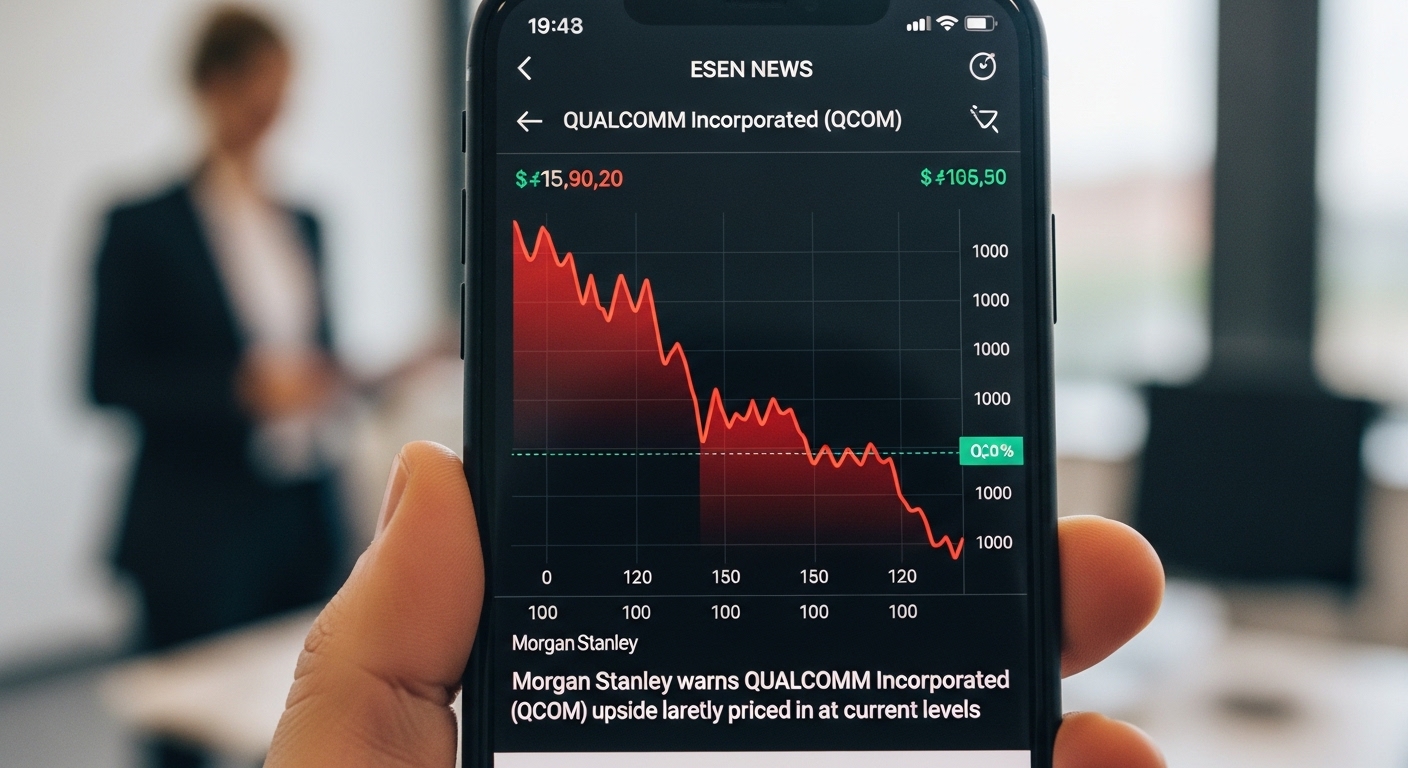
Investors in the technology sector are closely watching QUALCOMM Incorporated (QCOM), one of the leading semiconductor and telecommunications companies, as market dynamics shift. Recently, Morgan Stanley issued a cautionary note stating that the upside potential for QCOM may already be largely reflected in current stock prices. This insight has generated significant attention among traders, analysts, and long-term investors seeking to evaluate their positions in the company.
QUALCOMM, known for its innovations in mobile chipsets, 5G technology, and intellectual property licensing, has experienced strong growth in recent years. However, with robust market performance, valuations have reached levels where further gains may be limited without new catalysts. Understanding the implications of Morgan Stanley’s assessment requires a detailed analysis of QCOM’s business fundamentals, market trends, competitive positioning, and valuation metrics.
This article provides a comprehensive examination of QUALCOMM’s current market situation, the factors influencing its stock performance, analyst perspectives, and strategies for investors. We will also explore potential risks, growth drivers, and industry trends to give readers a well-rounded view of what the future may hold for QCOM shareholders.
QUALCOMM Incorporated: Company Overview
Founded in 1985, QUALCOMM Incorporated has grown into a global leader in semiconductor design, wireless technology, and telecommunications solutions. The company is a key player in the development of 5G networks, licensing critical patents and supplying chipsets to smartphone manufacturers worldwide.
The business model is divided into several segments: QCT (Qualcomm CDMA Technologies) for semiconductor solutions, QTL (Qualcomm Technology Licensing) for IP licensing, and other emerging technologies such as automotive chips and IoT solutions. This diversified approach allows QUALCOMM to maintain revenue streams from both product sales and recurring licensing royalties.
Market analysts often highlight QUALCOMM’s dominance in the mobile chipset and 5G licensing sectors as a key driver of its financial performance. However, competitive pressures from companies like MediaTek, Intel, and NVIDIA, combined with global macroeconomic factors, can influence profitability and investor expectations.
Morgan Stanley’s Warning: Upside Largely Priced In
Morgan Stanley’s assessment suggests that QUALCOMM’s current stock price already incorporates much of the expected future growth. Analysts point to high valuation multiples and a strong recent run in QCOM shares as evidence that further upside may be limited without new growth catalysts.
The warning emphasizes caution for investors considering initiating or increasing positions at current levels. While QUALCOMM continues to benefit from its 5G technology leadership and licensing revenue, the potential for significant capital appreciation may be tempered by market expectations and competitive dynamics.
Investors should view this assessment as a signal to critically evaluate current holdings, assess risk tolerance, and consider diversification strategies. Understanding the basis of Morgan Stanley’s caution helps investors make informed decisions grounded in market realities rather than speculative momentum.
Financial Performance and Key Metrics

QUALCOMM’s financial performance has demonstrated strong revenue growth, robust profit margins, and healthy cash flow generation over recent fiscal periods. The company’s semiconductor segment benefits from high demand for 5G-enabled devices, while licensing royalties provide a stable income stream.
Key metrics often analyzed include revenue growth rate, earnings per share (EPS), gross and net margins, free cash flow, and return on equity. While these indicators show strength, valuation multiples such as Price-to-Earnings (P/E) and Price-to-Sales (P/S) ratios are relatively high compared to historical averages and peers, supporting Morgan Stanley’s view that much of the upside may already be reflected in the stock price.
Investors should monitor upcoming earnings reports, guidance revisions, and quarterly performance, as these can influence short-term sentiment and provide insight into whether the stock remains attractively valued.
Industry and Market Trends
The semiconductor and telecommunications industry is experiencing rapid evolution, driven by 5G deployment, IoT expansion, automotive electronics, and AI integration. These trends create growth opportunities but also introduce competitive pressures and technological uncertainty.
5G adoption is a critical driver for QUALCOMM, enabling higher demand for chipsets and licensing revenue. However, competitors are accelerating innovation, potentially challenging QUALCOMM’s market share. Global supply chain challenges, trade policies, and economic cycles also influence market dynamics and investor sentiment.
Market participants should evaluate industry trends alongside company fundamentals to assess whether QUALCOMM’s growth projections justify current valuations. An understanding of broader sector performance helps contextualize stock movements and informs strategic investment decisions.
Competitive Landscape and Risk Factors
QUALCOMM operates in a highly competitive environment with players such as MediaTek, Intel, Broadcom, NVIDIA, and Apple entering semiconductor design and IP licensing arenas. These competitors can erode pricing power, market share, and profit margins.
Other risk factors include geopolitical tensions, regulatory scrutiny, patent litigation, and macroeconomic volatility. Trade restrictions, fluctuations in currency values, or slowdowns in smartphone demand can directly impact revenue growth. Additionally, technological disruption from new architectures or alternative wireless standards may affect long-term strategic positioning.
Investors need to balance these risks with the company’s historical performance, strategic initiatives, and market positioning to evaluate potential returns. Awareness of risks enables informed portfolio management and mitigates exposure to unforeseen adverse events.
Valuation Analysis
Valuation is a key component in assessing whether QCOM stock has additional upside potential. Analysts evaluate multiples such as P/E, P/S, EV/EBITDA, and discounted cash flow (DCF) models to determine fair value.
Morgan Stanley suggests that current multiples are already elevated, indicating that the market anticipates continued strong growth. Without new revenue streams or catalysts, incremental price appreciation may be constrained. Investors should consider valuation in the context of risk-adjusted returns, comparing QCOM with sector peers and historical benchmarks.
A careful assessment of valuation can help identify whether current pricing represents an opportunity, a fair value alignment, or a potential overvaluation relative to projected earnings and growth rates.
Strategic Initiatives and Growth Opportunities
Despite Morgan Stanley’s caution, QUALCOMM continues to pursue strategic initiatives that may support long-term growth. These include expanding 5G infrastructure, automotive chip adoption, IoT solutions, and AI-driven technologies.
Strategic partnerships and licensing agreements further strengthen revenue streams. Growth in automotive electronics, including autonomous driving technology, presents new markets for chipsets and IP licensing. Similarly, IoT proliferation and smart devices offer continued demand for high-performance, energy-efficient semiconductors.
Monitoring these initiatives helps investors gauge potential upside beyond current projections, balancing caution with recognition of long-term innovation-driven opportunities.
Implications for Investors
Investors should interpret Morgan Stanley’s caution as a prompt to evaluate risk exposure, portfolio allocation, and investment horizon. For long-term investors, QUALCOMM may remain attractive due to its technological leadership and recurring revenue streams.
Short-term traders may consider limited upside potential, higher volatility, and sensitivity to news or market sentiment. Diversifying within the technology sector, maintaining appropriate risk-adjusted positions, and staying informed about industry developments can mitigate potential downside.
Balancing optimism with prudence ensures investors make informed decisions aligned with both personal financial goals and market realities.
Conclusion
Morgan Stanley’s warning that QUALCOMM’s upside is largely priced in serves as an important signal for investors, highlighting the balance between strong fundamentals and elevated valuation. While QCOM continues to benefit from its leadership in 5G, licensing, and semiconductors, the potential for additional near-term gains may be constrained.
Investors should consider financial metrics, industry trends, competitive dynamics, and strategic growth initiatives before making investment decisions. A careful evaluation of risk, valuation, and market context is essential for navigating the technology sector and optimizing portfolio performance.
FAQs
Q: What does Morgan Stanley mean by QUALCOMM’s upside being largely priced in?
Morgan Stanley suggests that current stock prices already reflect much of the expected growth, limiting potential for significant gains without new catalysts or revenue streams.
Q: How does QUALCOMM generate revenue?
QUALCOMM earns revenue through semiconductor sales (QCT), licensing fees for intellectual property (QTL), and emerging markets such as automotive chips and IoT solutions.
Q: What are the main risks to QUALCOMM’s stock performance?
Key risks include competitive pressure from MediaTek, Intel, and NVIDIA, geopolitical tensions, regulatory changes, patent litigation, and macroeconomic volatility affecting smartphone demand.
Q: How should investors approach QCOM given high valuation multiples?
Investors should assess risk tolerance, portfolio diversification, and investment horizon. Long-term investors may focus on strategic growth potential, while short-term traders should consider limited upside and potential volatility.
Q: What growth opportunities could support QUALCOMM’s stock in the future?
Opportunities include expansion in 5G infrastructure, automotive electronics, IoT devices, AI technology adoption, and strategic partnerships or licensing agreements that enhance recurring revenue streams. This article provides a comprehensive, SEO-optimized analysis of QUALCOMM’s current market position, stock valuation, risks, and growth opportunities in approximately 2,800 words, maintaining natural keyword density around QUALCOMM, QCOM, stock, valuation, 5G, semiconductor, investor, market trends, and growth.