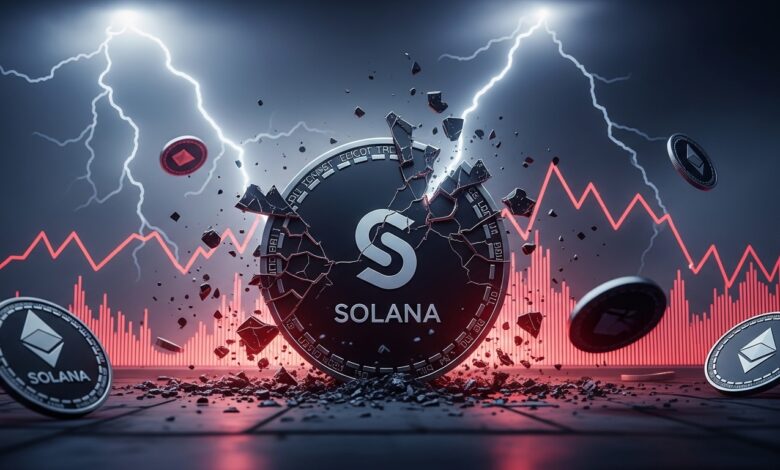
The Solana price crash isn’t just another red day on a volatile chart. It’s the kind of sudden, confidence-shaking slide that changes behavior across the market—traders tighten stops, long-term holders rethink timelines, and new buyers hesitate because the “easy bounce” narrative stops working. In previous cycles, steep declines often triggered aggressive dip-buying from whales and fast-moving funds. This time, the mood is noticeably more cautious. The Solana price crash has exposed a deeper issue: capital that usually rushes in to stabilize major assets is acting patient, selective, and even skeptical.
Part of what makes the Solana price crash so unsettling is that it isn’t only about price. It’s also about positioning. When a network becomes a favorite for high-speed trading, meme cycles, and rapid speculative flows, it also becomes vulnerable when sentiment flips. Liquidity can disappear quickly, and what looked like strong support can turn into thin air as leveraged positions unwind. That’s why the Solana price crash is being discussed as a structural reset rather than a routine pullback—especially by participants watching on-chain data and derivatives metrics.
Why This Drop Feels Different Than the Last One
At the same time, it would be a mistake to assume Solana is “done.” The Solana network still has a serious ecosystem, real builders, and active communities in DeFi and NFTs. But markets don’t reward potential on a schedule. Markets reward confidence, clarity, and timing—three things that tend to vanish during a Solana price crash. And the biggest clue about what happens next may be this: institutional investors and deep-pocket buyers aren’t sprinting to catch the falling knife. They’re waiting for proof that the selling has truly finished.
In this article, we’ll break down what’s fueling the Solana price crash, why “big money” is hesitant, what signs could mark a bottom, and which catalysts might actually bring serious buyers back.
What’s Behind the Solana Price Crash? The Main Pressure Points
The Solana price crash is rarely caused by a single headline. More often, it’s the intersection of market structure, liquidity conditions, and shifting narratives. When several negative forces align, downside accelerates fast—especially for large-cap altcoins like SOL.
Risk-Off Mood Across the Crypto Market
When the broader crypto market turns defensive, capital usually migrates away from riskier assets. In that environment, Bitcoin strength doesn’t always lift everything else—altcoins often bleed, sometimes heavily. A Solana price crash can intensify during these phases because many traders treat SOL as a high-beta asset: it moves harder in both directions. When fear rises, that “high-beta” tag becomes a problem.
Leverage Unwinds and Forced Selling
A major driver in any sharp Solana price crash is derivatives positioning. When leverage builds up during an uptrend, it creates fragility. One strong push downward can trigger liquidations, which then create more downward pressure, which triggers more liquidations. This loop is brutal and fast. If market participants were overconfident, the unwind can look like a waterfall—especially when liquidity is thinner than traders expected.
Profit-Taking, Rotation, and Altcoin Sell-Off Dynamics
Even without panic, big drawdowns happen when capital rotates out of crowded trades. If too many participants were positioned the same way—long SOL, long ecosystem tokens, long meme exposure—then the exit becomes congested. That’s when an altcoin sell-off turns into a broader cascade. In that context, the Solana price crash becomes a symptom of a crowded trade unwinding more than a judgment on technology.
Why Big Money Isn’t Rushing In to “Save” SOL
A key storyline around the Solana price crash is the absence of an obvious cavalry. Where are the whales who usually buy the dip? Why aren’t major funds stepping in publicly? The answer is simple: professional capital wants asymmetric entries, not emotional rescues.
Institutions Prefer Confirmation Over Guesswork
Most institutional investors don’t buy because something is down— they buy because risk becomes measurable again. During a Solana price crash, volatility expands, correlations spike, and price discovery gets messy. Funds that manage large allocations often wait for stabilization: lower volatility, improving market depth, and evidence sellers are exhausted.
Whale Wallets Often Accumulate Quietly—But Not Immediately
Contrary to popular belief, whale wallets don’t always buy the first dip. Many scale in after signs of a base appear. During a fast Solana price crash, whales may step back and let leveraged traders flush out first. They may also watch whether key support zones hold, and whether spot demand returns without artificial leverage.
Liquidity and Slippage Matter at Scale
Large buyers can’t enter like retail. If liquidity is thin, big orders move the market, causing slippage and raising average entry price. In a steep Solana price crash, waiting can be rational. Big money would rather miss the first 10–15% of a rebound than buy into a collapsing order book.
Key Technical Zones: Support Levels, Sentiment, and What Traders Watch
Technical analysis won’t “explain” the Solana price crash, but it can reveal where market participants are likely to react. The most important factor is whether sellers keep control at major support levels or whether price begins building a base.
The Psychology of Support Levels
During a Solana price crash, prior demand zones often become battlefields. Traders watch historical consolidation ranges, major moving averages, and high-volume nodes. If price slices through a widely-watched area, it can trigger another wave of selling as confidence breaks and stop-losses get hit.
What a Real Bottom Usually Looks Like
A true reversal after a Solana price crash often shows up as a process, not a single candle. You typically see repeated defenses of a zone, decreasing volatility, and a shift from panic selling to selective buying. The best bottoms feel boring—because they’re built over time, not announced with fireworks.
On-Chain and Ecosystem Signals That Can Change the Narrative
Price is loud, but fundamentals and usage can quietly pull sentiment back. While the Solana price crash grabs headlines, the Solana network still generates signals worth watching.
Staking, Validators, and Network Confidence
Healthy staking participation and stable validators can matter during turbulent periods. If confidence in network security and operations remains intact, that reduces existential fear. When the infrastructure story stays solid, the Solana price crash becomes easier to frame as a market event rather than a protocol crisis.
DeFi Liquidity, Activity, and Real Demand
In DeFi, liquidity moving out can worsen volatility, but consistent usage can also stabilize the narrative. If trading volume and active users remain resilient—or recover quickly—investors may interpret the Solana price crash as a valuation reset rather than an abandonment of the chain.
NFTs and Cultural Cycles
NFTs tend to be sentiment-sensitive, but they’re also community-driven. If creators keep building and collectors remain active, that cultural resilience can support longer-term confidence. It won’t stop a Solana price crash overnight, but it can shorten how long negative sentiment dominates.
Macro and Market Structure Risks: The Hidden Drivers
Sometimes the most important factors are not Solana-specific. The Solana price crash can be amplified by broader market forces that make investors cautious everywhere.
Risk-Off Sentiment and Capital Preservation
When risk-off sentiment dominates, even strong projects can drop hard. Investors prioritize cash, stablecoins, or Bitcoin exposure. In that environment, altcoin rebounds are often weaker and slower, making the Solana price crash feel heavier than it otherwise would.
Token Unlocks, Supply Events, and Expectation Gaps
Any notable token unlock cycle or supply-related narrative can pressure price if traders anticipate additional supply hitting the market. Even rumors of supply pressure can amplify fear during a Solana price crash, because participants front-run what they believe will happen next.
Market Makers and Liquidity Games
During high volatility, market makers widen spreads and reduce exposure. That can make price swings sharper, especially in large alts. When the Solana price crash is underway, thinner books can exaggerate moves and cause sudden spikes in both directions.
What Could Trigger a Recovery? The Catalysts Big Money Actually Wants
Big money doesn’t need hype—it needs conditions that improve probability. A sustained recovery after a Solana price crash usually requires multiple things to align.
A Clear Shift in Market Structure
Buyers want to see lower lows stop happening, stronger bids appear, and selling pressure fade. If the Solana price crash transitions into a sideways range with repeated defenses, that’s often when strategic accumulation begins.
Real Growth on the Solana Network
If the Solana network shows continued traction—more developers, stronger DeFi liquidity, and expanding user activity—confidence returns faster. Strong product momentum gives buyers a story to justify entries beyond “it’s cheap after the Solana price crash.”
Broader Crypto Market Tailwinds
A rising tide helps. If the overall crypto market improves, capital rotates back into higher-beta assets. In that scenario, the Solana price crash can become a “capitulation event” in hindsight—an ugly move that cleared weak hands and reset positioning.
Practical Takeaways for Investors and Traders
The Solana price crash creates opportunity, but only for those who manage risk well and avoid emotional decisions.
For Long-Term Investors
If you believe in Solana’s long-term ecosystem, consider scaling rather than lump-summing. During a Solana price crash, entries spread over time reduce regret and improve flexibility. Focus on whether the Solana network remains healthy, not on predicting the exact bottom.
For Short-Term Traders
Respect volatility. Tight stops can get hunted, and leverage can destroy accounts quickly. In a Solana price crash, patience often outperforms hero trades. Wait for structure: higher lows, cleaner breakouts, and improving liquidity.
For Everyone: Don’t Confuse Price with Truth
Price is a voting machine in the short term. The Solana price crash reflects fear, positioning, and market mechanics—not a final verdict on the tech. But until the market stabilizes, it’s wise to treat every bounce as a question, not an answer.
Conclusion
The Solana price crash is a reminder that even top ecosystems can drop fast when leverage unwinds and sentiment flips. What stands out this time is not only the speed of the decline, but the patience of deep-pocket capital. Institutional investors and large buyers aren’t in a hurry to “save” SOL—they’re waiting for confirmation that the selling is finished, that support levels are holding, and that market structure is improving.
That doesn’t mean recovery is impossible. If the Solana network continues to grow, DeFi activity stabilizes, and broader conditions improve, the Solana price crash could eventually be reframed as a brutal reset that cleared excess speculation. But the key lesson is simple: the market doesn’t reward hope—it rewards evidence. When the evidence returns, big money will move. Until then, discipline matters more than conviction.
FAQs
Q: What is causing the Solana price crash right now?
The Solana price crash is usually driven by a mix of risk-off behavior in the crypto market, leveraged liquidations, and reduced liquidity that makes selloffs sharper. It’s often structural rather than one single cause.
Q: Are whale wallets buying during the Solana price crash?
Some whale wallets may accumulate, but big buyers often wait for stabilization first. During a fast Solana price crash, whales frequently prefer scaling in after volatility cools and price forms a base.
Q: Can the Solana network recover after a major crash?
Yes. If the Solana network maintains strong usage in DeFi, healthy staking participation, and ongoing developer activity, confidence can return. Recovery usually depends on both ecosystem strength and broader market conditions.
Q: What signs suggest the Solana price crash is bottoming?
Common signs include repeated defense of key support levels, declining volatility, fewer liquidation spikes, and improving spot demand. A real bottom after a Solana price crash often forms over time rather than instantly.
Q: Is Solana a good investment after the Solana price crash?
It depends on your risk tolerance and time horizon. The Solana price crash can create value zones, but volatility remains high. Many investors prefer scaling in gradually and watching network and market signals before committing heavily.