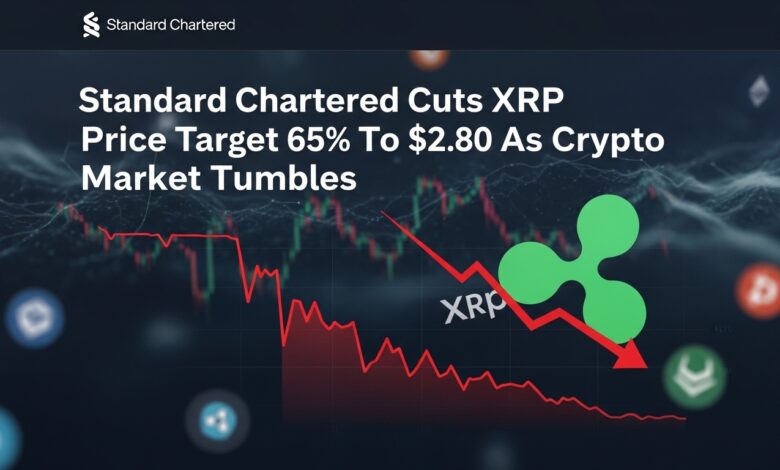
The cryptocurrency market has once again entered a period of heightened volatility, leaving investors searching for clarity in an increasingly uncertain landscape. In a significant development, Standard Chartered cuts XRP price target 65% to $2.80 as the broader crypto market tumbles. This sharp revision has sparked intense discussion among traders, analysts, and long-term holders who are evaluating what this downgrade could mean for XRP and the wider digital asset ecosystem.
Price target revisions from major financial institutions often act as powerful sentiment indicators. When a global banking institution adjusts its outlook so dramatically, it reflects both macroeconomic concerns and specific asset-level analysis. The announcement that Standard Chartered cuts XRP price target by such a substantial margin underscores the cautious tone currently dominating the crypto market outlook.
XRP, known for its focus on cross-border payments and institutional partnerships, has long been viewed as a bridge between traditional finance and blockchain innovation. However, the recent downturn in digital asset prices has affected nearly all major cryptocurrencies. As investors digest the news that Standard Chartered cuts XRP price target to $2.80, many are reassessing risk exposure, market cycles, and long-term growth potential.
This article provides a comprehensive analysis of the downgrade, its implications for XRP price prediction models, the broader digital asset market, and how investors can navigate ongoing volatility.
Understanding Why Standard Chartered Cuts XRP Price Target
When Standard Chartered cuts XRP price target by 65%, it is not a decision made lightly. Institutional analysts typically evaluate multiple variables before revising projections. These include macroeconomic indicators, regulatory developments, liquidity conditions, and network-level fundamentals.
The crypto market has recently faced mounting pressure from tightening monetary policies and reduced speculative liquidity. As global central banks maintain cautious stances, risk assets including cryptocurrencies often experience downward pressure. In this context, the decision that Standard Chartered cuts XRP price target reflects a recalibration of expectations rather than a sudden loss of confidence in the asset’s long-term viability.
Another contributing factor may be shifting investor sentiment. During bullish phases, optimistic forecasts dominate headlines. Conversely, when the crypto market tumbles, analysts tend to adopt more conservative outlooks. The downgrade to $2.80 signals that near-term headwinds could delay broader recovery.
Institutional price targets often influence retail behavior. While they do not guarantee market movement, they shape narratives that can impact trading psychology and short-term volatility.
The Current State of the Crypto Market
To fully grasp why Standard Chartered cuts XRP price target, it is essential to analyze the broader market environment. The crypto market has experienced cyclical expansions and contractions since its inception. Periods of rapid growth are frequently followed by corrections that test investor resilience.
Recent turbulence has been driven by declining trading volumes, macroeconomic uncertainty, and cautious institutional positioning. As speculative capital retreats, even fundamentally strong projects can experience price declines.
Bitcoin’s performance often sets the tone for altcoins. When Bitcoin struggles to maintain upward momentum, altcoins like XRP typically face amplified volatility. The broader cryptocurrency market analysis suggests that risk appetite remains subdued, contributing to downward pressure across digital assets.
Liquidity constraints also play a significant role. Reduced liquidity can magnify price swings and increase sensitivity to negative news. In such an environment, institutional downgrades carry heightened weight.
XRP’s Market Position and Fundamentals
XRP has carved out a unique position within the crypto ecosystem. Unlike many speculative tokens, XRP’s primary use case revolves around facilitating cross-border payments and improving settlement efficiency. Its association with financial institutions has historically differentiated it from purely decentralized cryptocurrencies.
Despite this strategic positioning, XRP remains subject to overall market cycles. When the crypto market tumbles, correlation effects often overshadow individual project fundamentals.
From a technical perspective, XRP’s price movement is influenced by trading volume, market sentiment, and key support and resistance levels. The announcement that Standard Chartered cuts XRP price target to $2.80 may shift attention toward critical price zones where buyers could re-enter.
Fundamentally, XRP continues to develop partnerships and expand adoption. However, short-term price targets often reflect broader macro risks rather than solely project-specific developments.
Market Reaction to the $2.80 Target
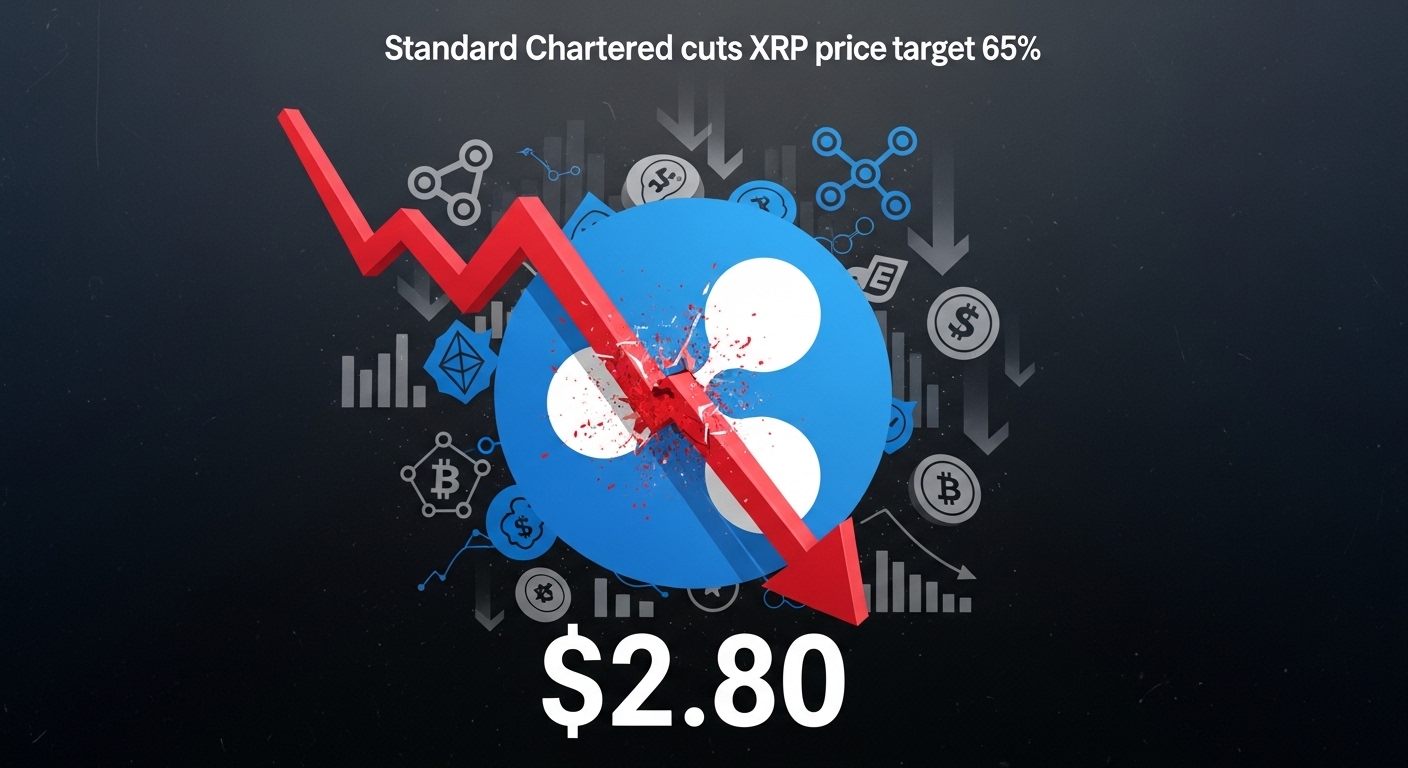
When Standard Chartered cuts XRP price target by 65%, traders react in different ways. Some interpret the downgrade as confirmation of bearish momentum, while others see it as an opportunity to accumulate at lower levels.
Institutional downgrades can initially increase selling pressure, especially among short-term traders seeking to avoid further downside. However, long-term investors often focus on broader adoption trends and historical recovery patterns.
Volatility typically rises following significant forecast adjustments. Increased trading activity may accompany attempts to test new support levels.
It is important to recognize that price targets are forward-looking estimates, not guarantees. Markets frequently overshoot or undershoot analyst projections based on sentiment shifts and macro developments.
The Role of Macroeconomic Factors
Macroeconomic trends significantly influence cryptocurrency valuations. Inflation data, interest rate policies, and global economic growth projections all affect investor appetite for risk assets.
When liquidity tightens and borrowing costs rise, speculative investments often decline. This environment contributes to broader corrections in digital assets.
The fact that Standard Chartered cuts XRP price target during a period of market turbulence highlights how macro uncertainty shapes institutional analysis. If economic conditions stabilize and risk appetite returns, projections may shift once again.
Additionally, geopolitical events can impact digital asset markets. Regulatory clarity, technological advancements, and global adoption trends also factor into long-term price outlooks.
Technical Analysis and Price Structure
From a technical standpoint, XRP’s price structure reveals important insights. Long-term charts often display cyclical patterns, with consolidation phases preceding significant breakouts.
A revised target of $2.80 may align with specific technical levels identified by analysts. These levels often correspond to previous resistance zones or Fibonacci retracement points.
Traders closely monitor moving averages, momentum indicators, and volume trends to gauge potential reversals. If XRP establishes strong support above key thresholds, the bearish outlook could soften.
Conversely, failure to hold support levels may reinforce cautious projections. Technical analysis complements fundamental insights, offering a multidimensional perspective on price movement.
Investor Sentiment and Psychological Impact
Investor psychology plays a central role in cryptocurrency markets. Headlines such as “Standard Chartered Cuts XRP Price Target 65% To $2.80 As Crypto Market Tumbles” can amplify fear during already volatile periods.
Sentiment indicators often reveal extremes of optimism or pessimism. Historically, periods of heightened fear have preceded recovery phases. However, timing such reversals remains challenging.
Retail investors may react emotionally to institutional downgrades. Experienced market participants often adopt a more measured approach, focusing on long-term fundamentals and risk management strategies. Understanding the psychological impact of price target revisions helps investors avoid impulsive decisions.
Long-Term Outlook for XRP
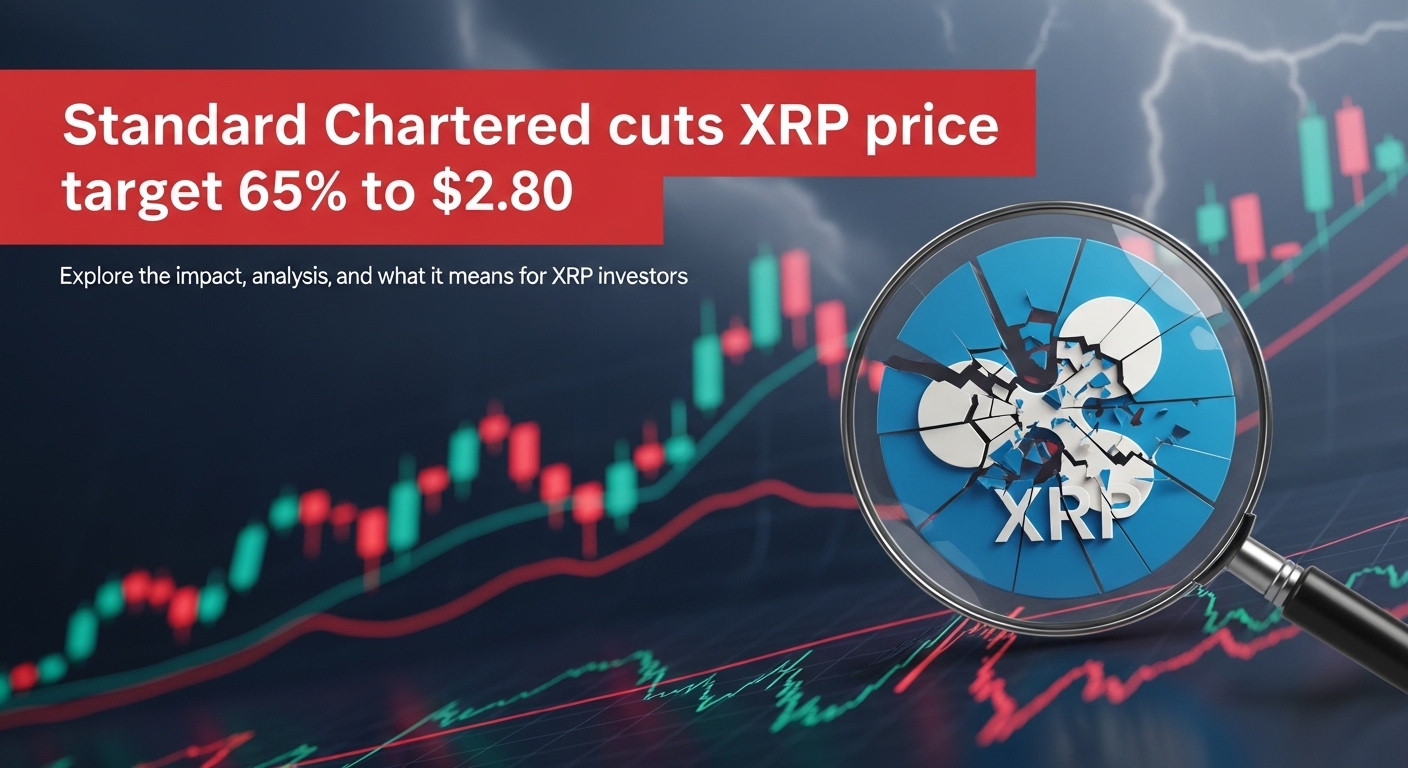
Despite short-term turbulence, XRP’s long-term prospects depend on adoption, technological innovation, and regulatory clarity. Cross-border payment solutions remain a significant area of growth within global finance.
If institutional adoption accelerates and blockchain infrastructure continues evolving, XRP could benefit from renewed demand.
The decision that Standard Chartered cuts XRP price target does not necessarily negate long-term potential. Instead, it reflects current market conditions and revised risk assessments.
Long-term investors often evaluate multi-year trends rather than short-term price fluctuations. Market cycles suggest that downturns eventually give way to recovery, although timing remains uncertain.
Risk Management in Volatile Markets
Navigating volatile markets requires disciplined risk management. Diversification, position sizing, and strategic entry points are essential tools.
When headlines indicate that Standard Chartered cuts XRP price target, investors should reassess portfolio exposure rather than react impulsively.
Volatility can present both risks and opportunities. Those with long-term conviction may view corrections as accumulation phases, while short-term traders may adopt defensive strategies.
Maintaining a balanced perspective helps mitigate emotional decision-making during turbulent periods.
Conclusion
The announcement that Standard Chartered cuts XRP price target 65% to $2.80 as the crypto market tumbles underscores the challenges facing digital assets in uncertain economic conditions. While the downgrade reflects near-term caution, it does not eliminate XRP’s broader use case or potential for recovery.
Institutional forecasts influence sentiment, but they represent snapshots in time rather than definitive outcomes. As macroeconomic trends evolve and adoption continues, price targets may shift again.
Investors should remain informed, focus on risk management, and evaluate long-term fundamentals alongside short-term market dynamics. The cryptocurrency landscape remains dynamic, and resilience often defines successful participants in this evolving ecosystem.
FAQs
Q: Why did Standard Chartered cut XRP price target by 65%?
Standard Chartered cut XRP price target primarily due to broader crypto market turbulence and macroeconomic uncertainty. Tight liquidity conditions, reduced risk appetite, and shifting investor sentiment likely influenced the revision. Institutional forecasts often adjust to reflect prevailing economic conditions and updated risk assessments.
Q: Does a $2.80 price target mean XRP will fall to that level?
A price target represents an analyst’s projection based on current data and assumptions. It does not guarantee that XRP will reach $2.80. Market prices can fluctuate above or below projections depending on liquidity, sentiment, and external developments.
Q: How does the crypto market downturn affect XRP specifically?
During market downturns, most cryptocurrencies experience correlated declines due to reduced liquidity and investor caution. XRP is influenced by overall market trends, even though it maintains distinct fundamentals related to cross-border payments and institutional partnerships.
Q: Should investors be concerned about XRP’s long-term prospects?
Short-term volatility does not necessarily determine long-term outcomes. XRP’s long-term prospects depend on adoption, regulatory clarity, and technological development. Investors should evaluate both macro conditions and project fundamentals when forming conclusions.
Q: What strategies can investors use during crypto market turbulence?
Investors can use diversification, disciplined position sizing, and long-term planning to manage risk during turbulent periods. Avoiding emotional decisions and focusing on data-driven analysis helps maintain stability in volatile markets.